

The world of crypto trading bots is evolving at an impressive pace. Where it once took months of trial and error to design a viable automated strategy, AI for crypto trading now offers a valuable shortcut, not by trading on your behalf, but by forcing you to structure your thinking like a true professional strategy developer.
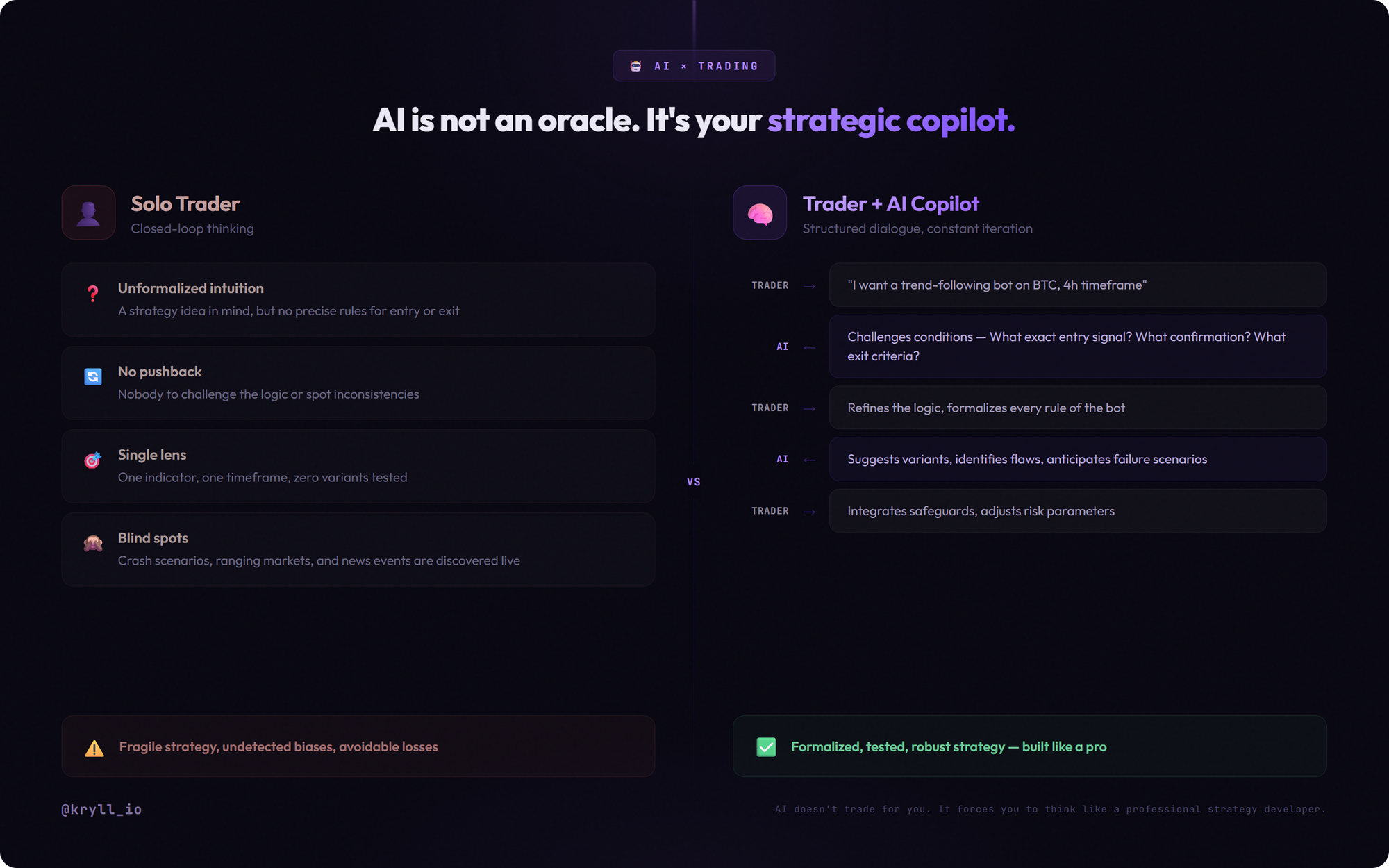
This is the most common misconception: AI is not an oracle that predicts markets. It's a strategic copilot, a demanding interlocutor capable of challenging every decision you make when building your bot and managing its risk.
Let's look concretely at how it transforms the two fundamental pillars of a high-performing bot: strategy and risk.
AI as a Copilot in Building Your Bot Strategy
Building a profitable trading strategy isn't simply a matter of picking an indicator and hitting "start." It's rigorous design work, where every rule must be thought through, tested, and justified. AI intervenes at every stage of this process, not to decide for you, but to push you to follow your reasoning all the way through.
Formalizing precise entry and exit conditions
It all starts with a deceptively simple question: when should the bot buy, and when should it sell?
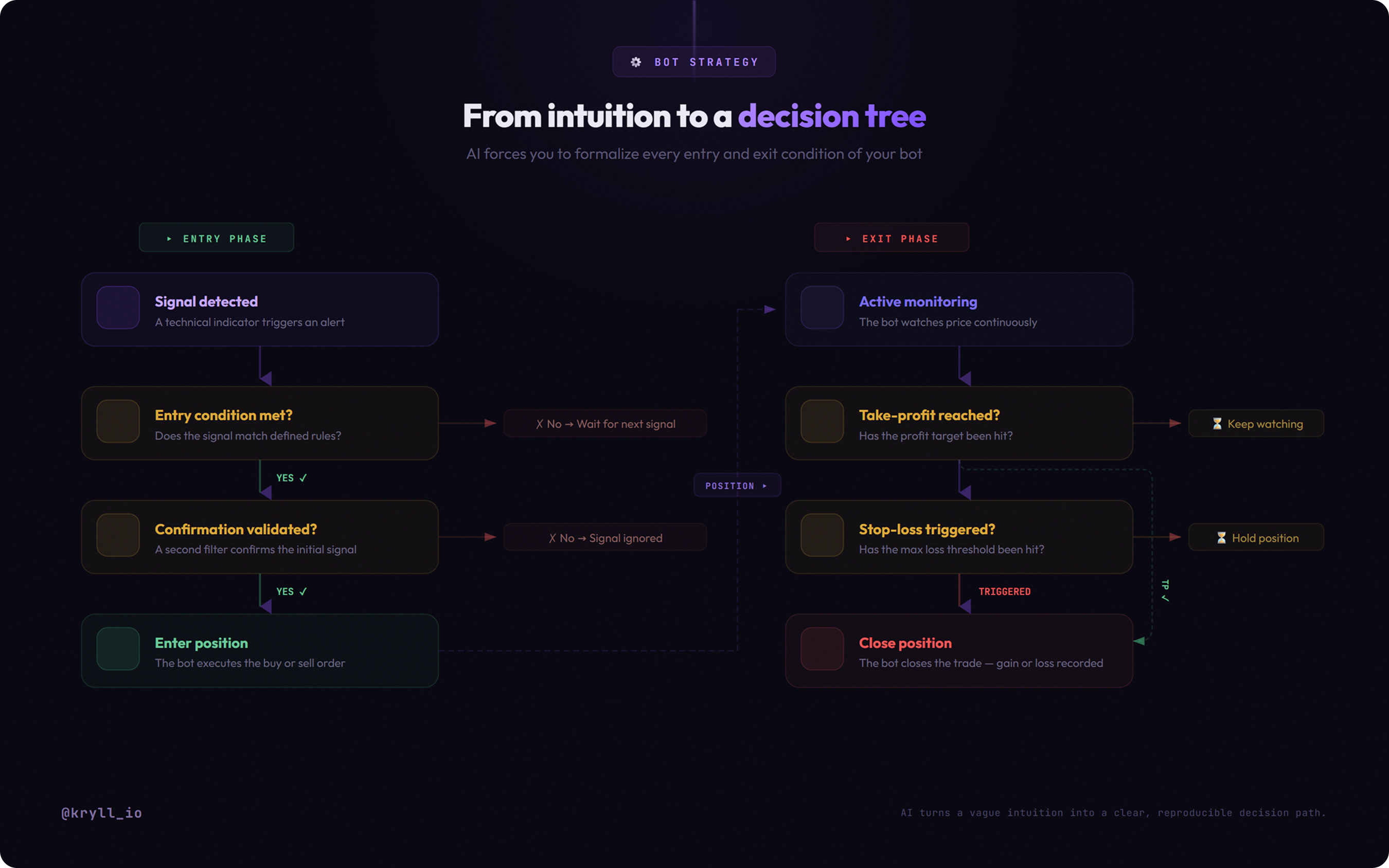
Most beginner traders start with a vague idea, whereas AI forces you to go much further. Through dialogue with it, you're led to precisely formulate your conditions: which indicator triggers the entry? What confirmation are you waiting for? What signal triggers the exit? This formalization work is crucial. A crypto trading bot built on fuzzy rules will produce inconsistent results. AI acts as an unforgiving mirror that transforms an intuition into a clear, reproducible set of rules.
Challenging the logic before writing a single line of code
This is arguably one of AI's most powerful contributions to algorithmic crypto trading: it intervenes before development even begins.
Is your entry condition compatible with your exit condition? Are there scenarios where the bot would remain stuck in a position with no closing signal? Does your logic hold up if the market suddenly shifts dynamics? An experienced strategy developer asks these questions naturally. AI allows an intermediate trader to develop the same reflexes, without years of trial and error.
Exploring variants to strengthen robustness
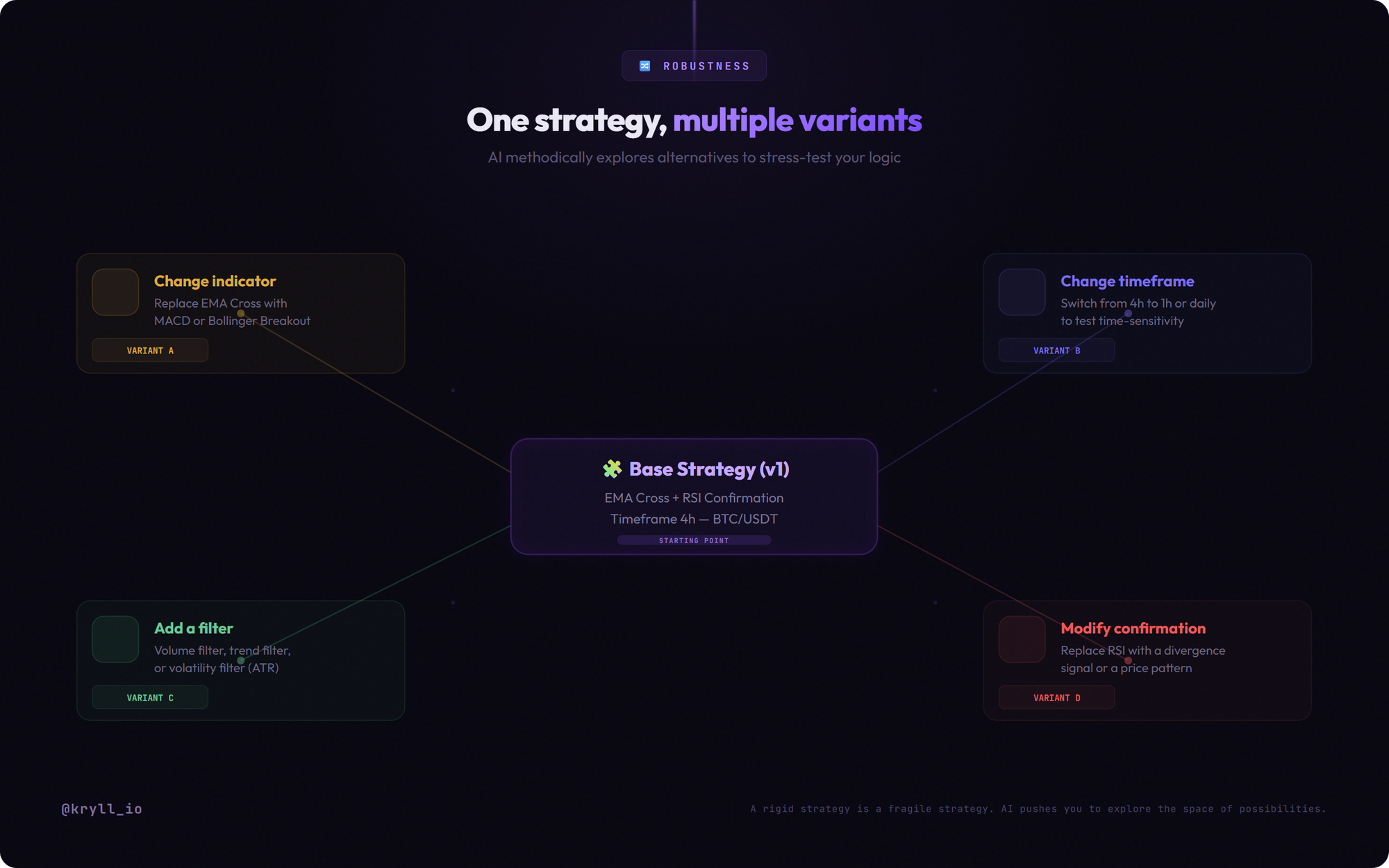
A rigid strategy is a fragile strategy, and this is where AI truly proves its value.
It excels at proposing variants: what if you changed the indicator? What if you switched to a different timeframe? What if you added an extra filter condition? This ability to methodically explore the space of possibilities is what distinguishes an amateur bot strategy from a professional approach. Rather than staying attached to a single idea, you learn to stress-test your logic from different angles, exactly as a quant team at a fund would do.
Anticipating scenarios where the bot will struggle
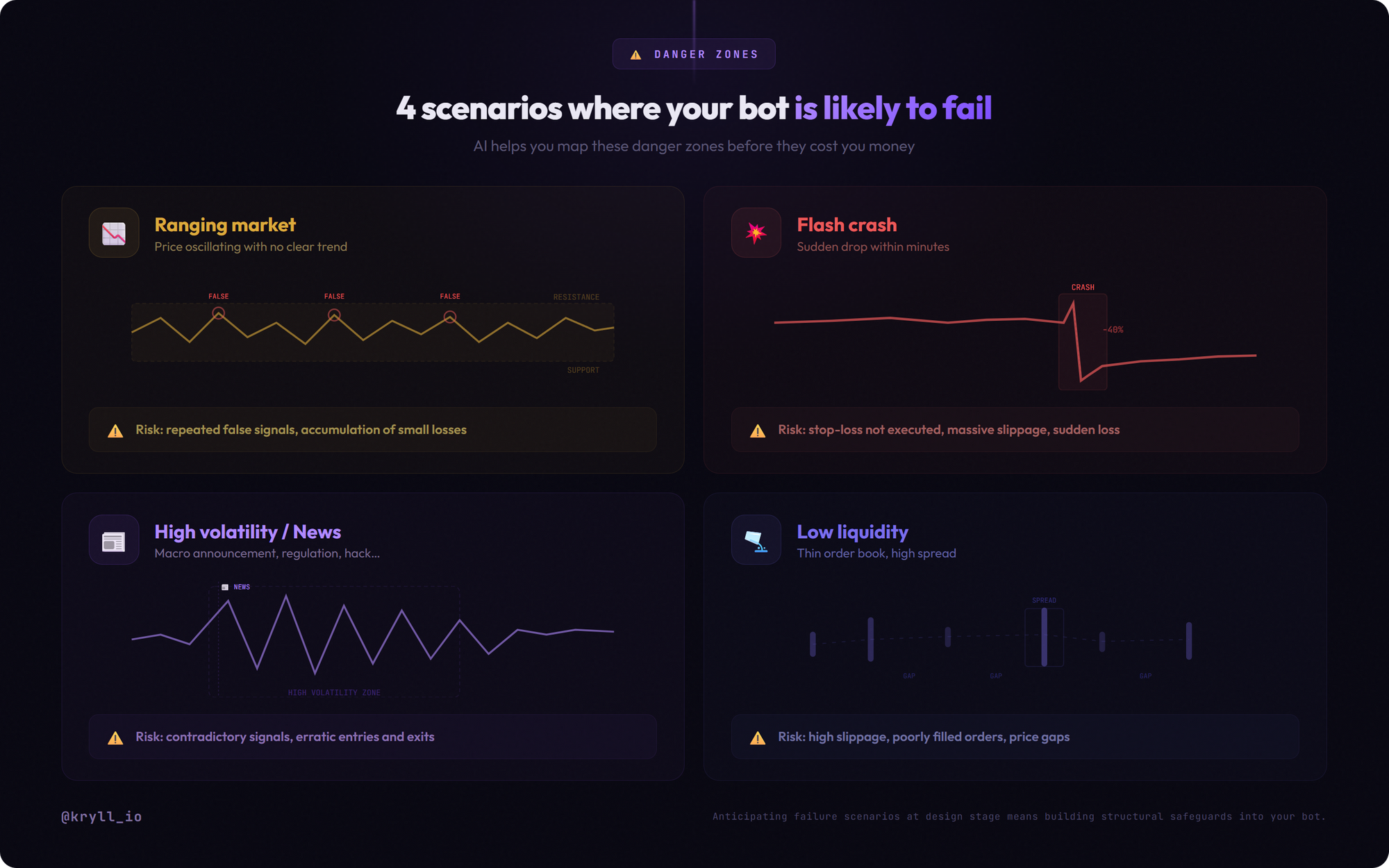
Every bot eventually encounters unfavorable market conditions. The real challenge isn't avoiding them, it's identifying them in advance.
Rangebound markets with no clear trend, volatility spikes linked to macroeconomic announcements, periods of low liquidity, flash crashes, AI helps you map these danger zones for your crypto trading bot. By anticipating these scenarios during the design phase, you build in structural safeguards rather than discovering the flaws after a series of losses.
AI in Service of Your Bot's Risk Management
A good strategy isn't enough. Without rigorous bot risk management, even the best entry signal can lead to significant losses. Here again, AI plays the role of copilot: it helps you build a risk framework that is coherent with your strategy's logic, rather than artificially bolted on top of it.
Defining position sizing that actually makes sense
The size of each position is one of the most underestimated parameters in algorithmic trading, and yet one of the most decisive.
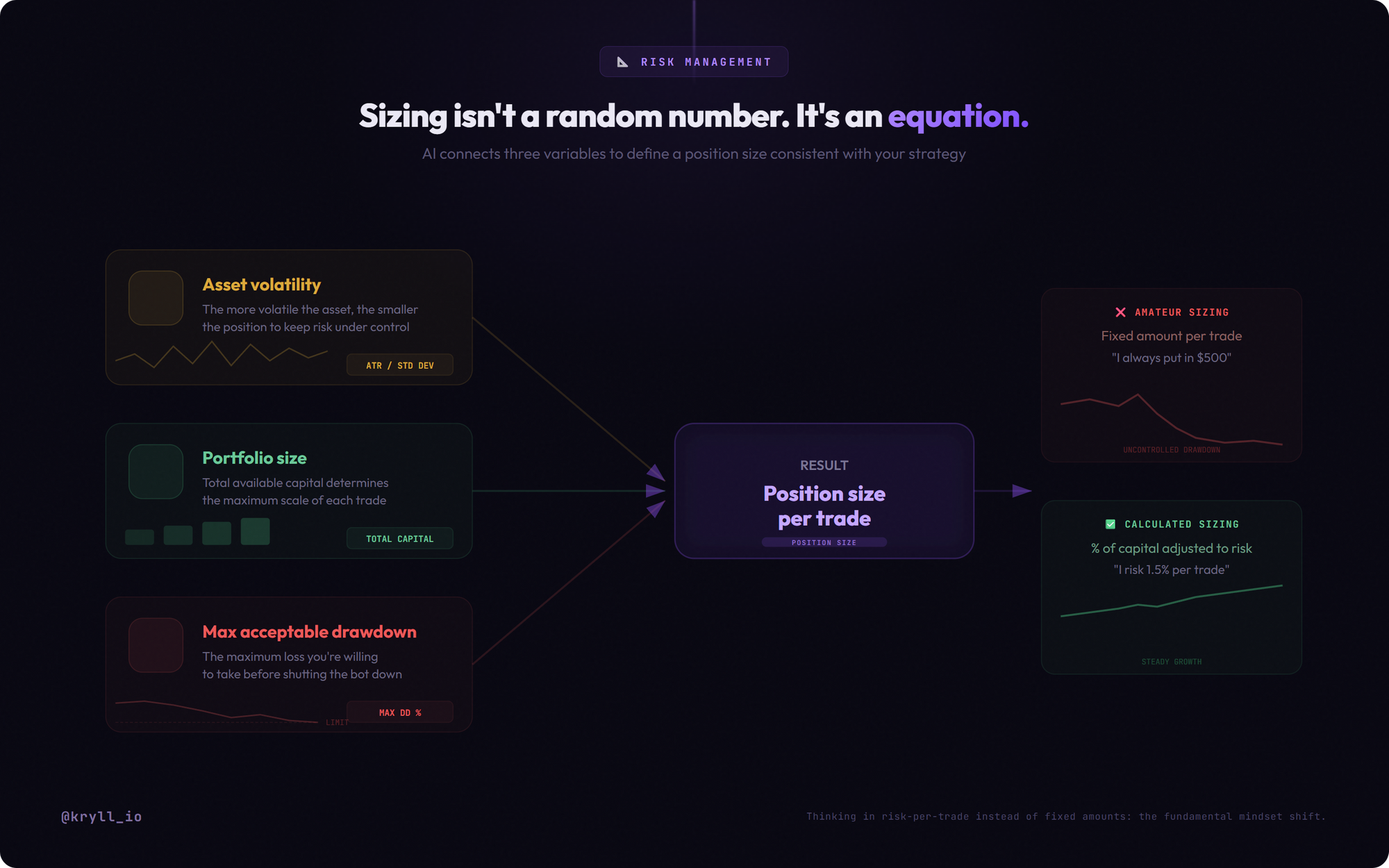
A bot can have excellent entry and exit logic and still collapse because the sizing is poorly calibrated. AI guides you through this thinking by linking your position sizes to the asset's volatility, your portfolio size, and the maximum drawdown you're willing to accept. It pushes you to think in terms of risk per trade rather than absolute amounts, a fundamental shift in perspective for anyone looking to move from amateur trading to serious algorithmic crypto trading.
Reading a backtest with a critical eye
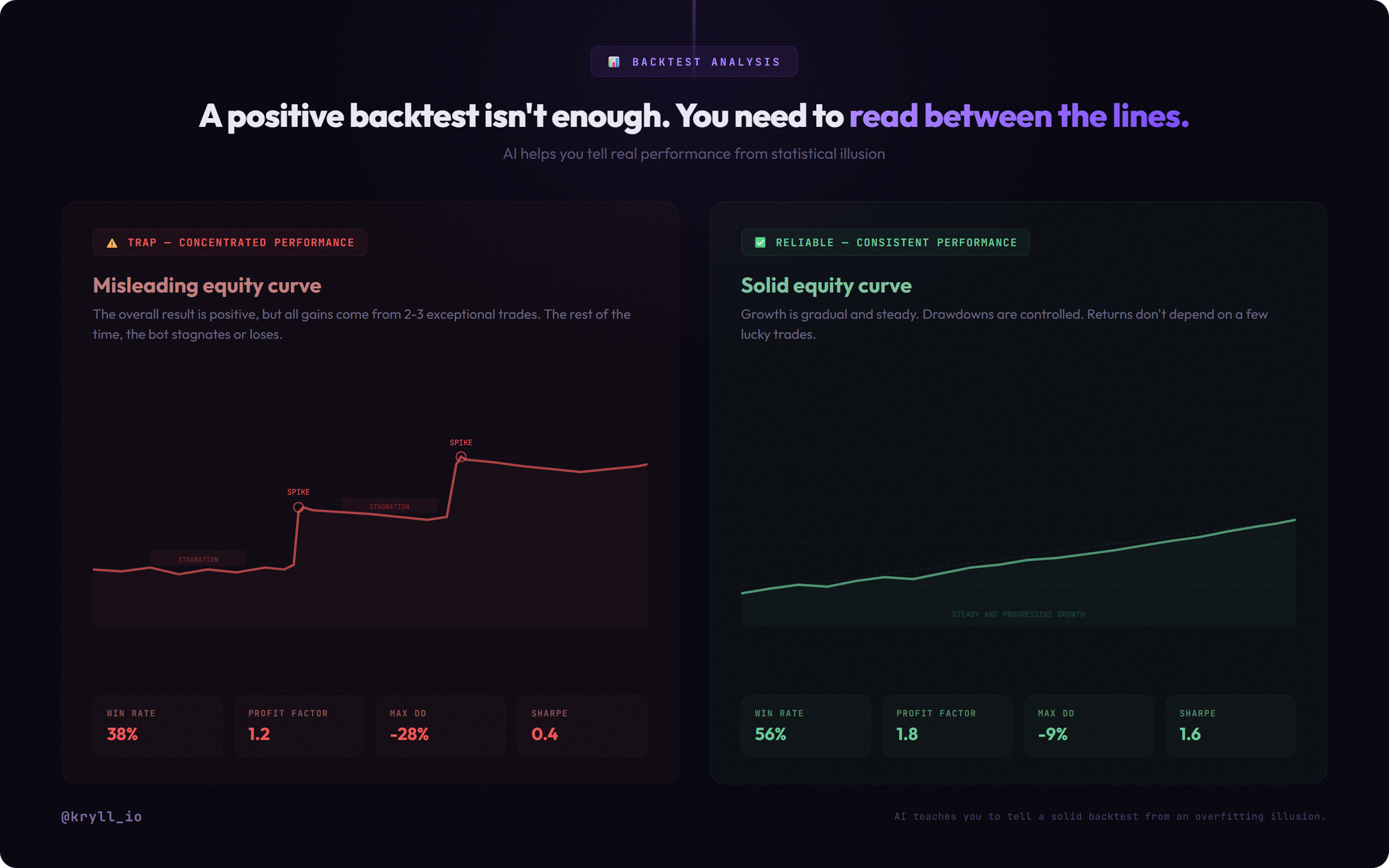
A positive backtest isn't enough, and this is precisely where many traders get caught out.
AI helps you read between the lines: does the performance rest on a few exceptional trades or on consistent regularity? Is the win/loss ratio stable over time, or concentrated in a specific period? Is the number of trades statistically significant? This careful analysis allows you to fine-tune your bot's parameters with discernment, avoiding the classic trap of over-optimization, that illusion where a bot looks perfect on historical data but falls apart the moment it meets real market conditions.
Building stop-losses and take-profits that are coherent with the strategy
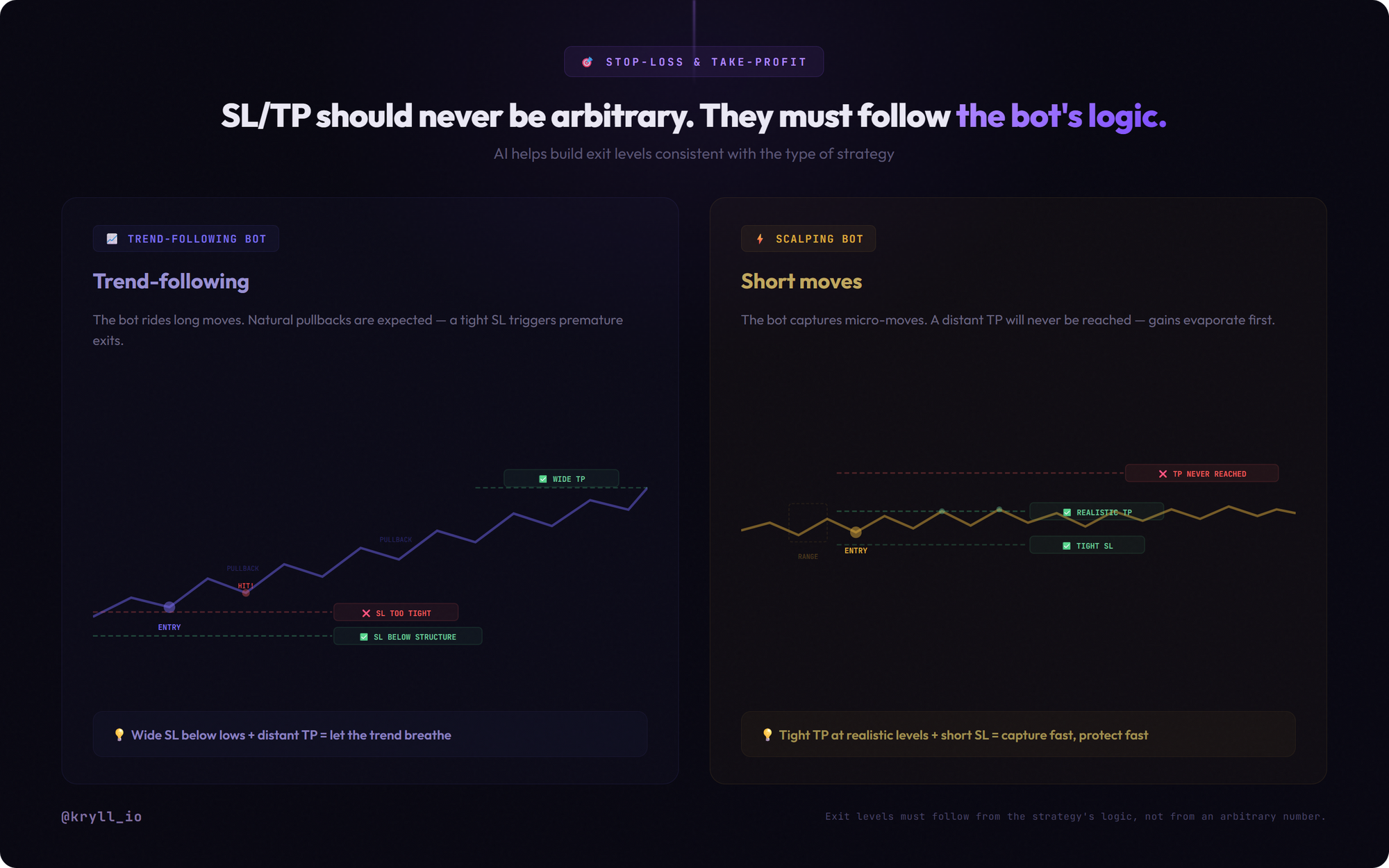
Stop-loss and take-profit levels should never be arbitrary. They must flow directly from your bot strategy's logic.
If your bot follows a trend, a stop-loss that's too tight will trigger premature exits on simple retracements. If your bot captures short moves, a take-profit set too wide will let gains evaporate. AI helps you build this coherence, so that bot risk management becomes a natural extension of the strategy, not a superficial add-on decided at the last minute.
Conclusion
AI for crypto trading replaces neither the trader nor the developer. It occupies a more subtle and perhaps more valuable role: that of a rigorous copilot who forces you to formalize, question, and refine every aspect of your crypto trading bot, from the first strategic idea through to the final risk management settings.
Ultimately, the real competitive advantage isn't having access to AI. It's learning, through it, to think like a professional.