
We're witnessing a rather peculiar situation right now. On one hand, Bitcoin is climbing and approaching $100,000. On the other, U.S. regulation is mired in uncertainty. The CLARITY Act, this much-anticipated legislation that was supposed to finally clarify crypto's legal status, has just been postponed. The result: price euphoria meets complete regulatory fog.
Bitcoin Shows No Signs of Slowing
It's hard to ignore what's happening in the market. Bitcoin is hovering around $97,000 and the trend remains clearly positive. What's striking is the confidence of major investors.
ETFs Are Changing the Game
The real engine behind this rally is institutional money. The numbers are impressive: in three days, Bitcoin ETFs absorbed $1.7 billion. Some days even exceeded $850 million in net inflows.
BlackRock is leading the charge, as usual. But make no mistake, we're not talking about retail investors speculating on their phones here. No, these are pension funds, traditional asset managers, and family offices adding Bitcoin to their portfolios.
These players aren't gambling. They're treating Bitcoin as a serious asset, a legitimate investment class. The asset's scarcity justifies these massive purchases in their view, even as the political context remains murky.
Long-Term Vision Prevails
What's interesting is that these institutions don't seem too bothered by political back-and-forth. They invest over multiple years and view regulatory debates as temporary turbulence, not insurmountable walls.
The message is quite clear: today, it's institutional demand driving the price up. And it seems more sensitive to Bitcoin's scarcity than to the latest news from Washington.
Regulatory Fog Thickens
While prices climb, confusion reigns in Washington. The CLARITY Act was supposed to bring order. But things are getting complicated.
Why This Law Matters
The CLARITY Act is straightforward: draw a clear line between what falls under the CFTC (the commodity regulator) and the SEC (the financial watchdog). For Bitcoin, being considered a commodity rather than a security is crucial. It changes everything in terms of operational freedom and institutional adoption.
The idea isn't to stifle innovation, but to create a framework. Today, we regulate through lawsuits. That's not good for anyone.
Political Friction
Except the legislative process just ground to a halt. The Senate committee discussion was postponed, mainly because major players like Coinbase withdrew their support.
Coinbase was blunt: the current text has "too many problems." Better to wait than pass a bad law.
The sticking points? Several:
Stablecoins: certain provisions on yields offered worry the DeFi sector. Too many constraints risk killing innovation.
Tokenized equities: no one really agrees on their regulatory status. And that complicates integration with traditional finance.
How to Explain This Disconnect?
The market rises, the law stalls. Strange, isn't it? There are two ways to look at it.
Optimistic View: The Delay Protects Decentralization
For some, this postponement is actually good news. If the first version of the CLARITY Act gave too much power to traditional regulators, better to take time to rewrite the text properly. The idea: avoid a law that would strengthen intermediary control at the expense of decentralization.
Moreover, Bitcoin works perfectly fine without laws. Mining difficulty, network security, everything runs smoothly. For purists, Washington will never decide the technology's success.
Realistic View: Institutions Manage Risk Differently
The most likely explanation? The massive flows into ETFs mask the real importance of regulatory risk. Institutions focus on two concrete things: Bitcoin's scarcity (the Halving) and legal access via ETFs.
Regulatory risk exists, but they consider it manageable. They're not buying betting on the CLARITY Act. They're buying because they believe a total Bitcoin ban is now impossible in the United States.
Bottom line: capital flows drive the price, not legislative debates.
In Conclusion
We're walking a tightrope. On one side, enormous institutional demand propels Bitcoin toward new highs and validates the idea of a digital reserve asset. On the other, the CLARITY Act postponement reminds us that full crypto integration into the U.S. financial system won't be a walk in the park.
The regulatory framework remains the main risk to watch in the coming months, especially after the next Halving. It's what will bring clarity where political noise currently dominates.
And you, what dominates your market view right now? The strength of price or regulatory uncertainty?
Navigating Uncertainty with the Right Tools
In a context where regulatory uncertainty can emerge at any moment and disrupt the market, the ability to quickly assess opportunities becomes crucial. While institutions focus on Bitcoin and major assets, numerous emerging projects are trying to capitalize on this bull phase. That's where vigilance becomes essential.
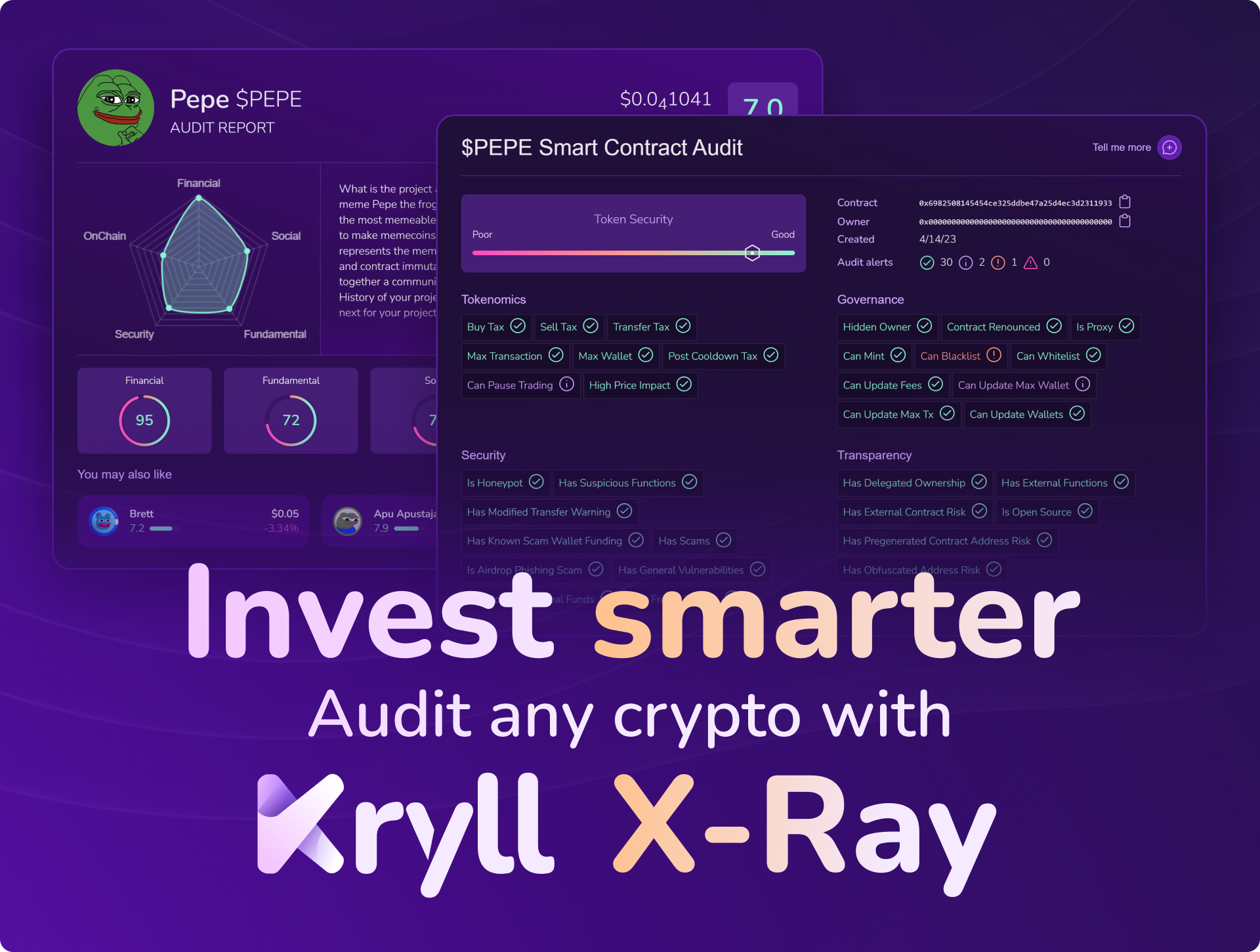
Kryll X-Ray helps you avoid traps in this token jungle. In seconds, you get a complete audit: smart contract analysis, on-chain data, financial metrics, and social signals. The tool automatically detects red flags (trapped contracts, unlimited mint, excessive holder concentration) that could cost you dearly in the heat of the moment.
The advantage? You don't need to be a technical expert. The intuitive interface and Kryll³ AI agent let you audit any project by conversing naturally, as if talking to an experienced crypto analyst. In a market where every decision counts and FOMO can push you toward dubious projects, having an intelligent dashboard that centralizes all critical data is no longer a luxury, it's a necessity. Discover X-Ray and audit any crypto.