Before risking capital on a strategy, you test it on historical data. That's the principle behind backtesting. Simple in concept, but the quality of the results depends entirely on the tool you use.
In KryllOS, we rebuilt the engine from the ground up. Here's what that means.
More accurate. And much faster.
The new backtest engine uses a 16-tick-per-candle interpolation system that produces results significantly closer to what would happen in live trading.
But accuracy is only half the story. The other half is speed. The new engine is radically faster than the old one. That speed gain genuinely changes the way you work: you iterate more, test more, validate faster.
Run multiple backtests at the same time
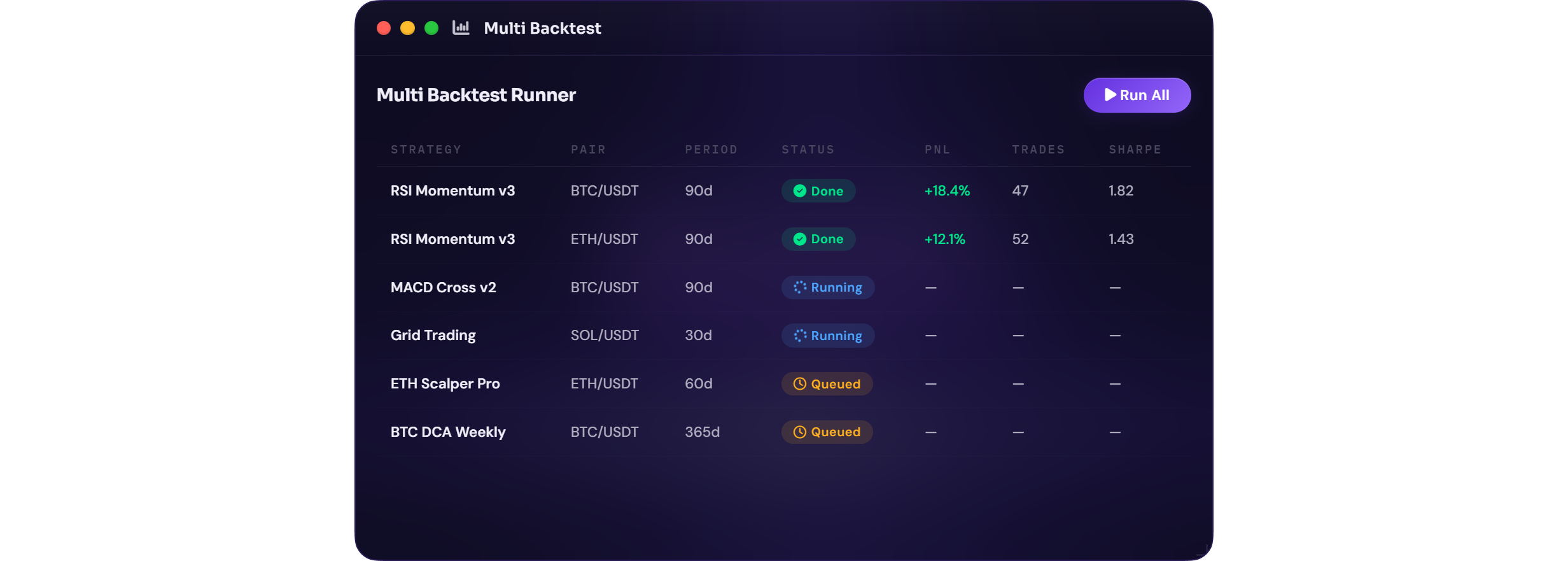
With MultiBT, you no longer run backtests one after another. You run them all at once.
This opens up concrete possibilities: testing a strategy across multiple time periods to verify it holds up over time, validating it on several pairs or assets simultaneously, or comparing multiple configurations of the same system in a single run.
What used to take an hour of sequential testing now runs in parallel. More comparisons, in less time, with a far more complete picture of what your strategy is actually worth.
Your backtests stay with you
KryllOS is self-hosted. Backtests run entirely on your machine, and no data leaves it, not your strategies, not your results, not the pairs you're testing. On a cloud platform, you're entrusting your ideas to a third party. With KryllOS, they truly belong to you.
An engine you can read
KryllOS is open source. The backtest engine is too. You can read exactly how the calculations are made, verify the interpolation logic, and make sure there are no hidden biases in the results.
In a field where trust in the tool matters as much as the tool itself, that's far from a minor detail.