Building a strategy is often a loop: you set a block, adjust a level, move a condition, and after every change the same question comes back, does it hold up? So you run a backtest, to ask the market's past what it thinks.
The problem is that every backtest has a cost in time. When waiting for a result takes several minutes, you become frugal: you only test the ideas you're already fairly sure about, and all the "what if I tried this" thoughts stay in a corner of your mind, never checked. Every one of those untested variants is a path you'll never actually know.
0.5.29 shifts that balance. As of this KryllOS version, backtests run much faster, fast enough that testing one more idea costs almost nothing, so there's no real reason to hold back anymore.
The waiting wall comes down
KryllOS's backtesting engine was already fast: it ran 2 to 10 times faster than the old engine. 0.5.29 adds up to another 4x on top of that. Long periods that used to take several minutes now run in seconds, and you can chain tests together without losing track of what you set out to check.
The cache that makes technical analysis free
Where does this speed come from? Largely from a cache, a memory the engine builds up across runs so it never has to redo the same work twice.
Specifically, two things now persist from one backtest to the next. Candles, first: the engine no longer has to fetch them from disk on every run, it keeps them on hand. Your indicators, second: your RSI, your moving averages, your Supertrend are no longer recalculated every time, they're computed once and reused.
The result: after the first pass, your technical analysis costs your machine almost nothing. The engine no longer spends its time rebuilding your indicators; it spends it replaying prices and measuring how your strategy behaves.
That's also why the very first run is a bit slower than the ones that follow: it's the one filling the cache. If your first backtest isn't instant, that's normal. Run it again, and you'll feel the difference.
Dead time, compressed
Speed doesn't only come from the cache. The way the engine replays the market has changed too.
A market doesn't move at a steady pace: there are moments when everything moves, and long stretches where nothing happens. Before, the engine still advanced step by step through those quiet stretches. Now, it crosses them in one go: uneventful ticks are compressed, candles that don't change anything for your strategy are skipped, and the engine jumps straight to the next event that actually matters to you.
It's a bit like fast-forwarding through the boring parts, with a return to normal speed only where something is really happening.
Precision: your cursor between speed and detail
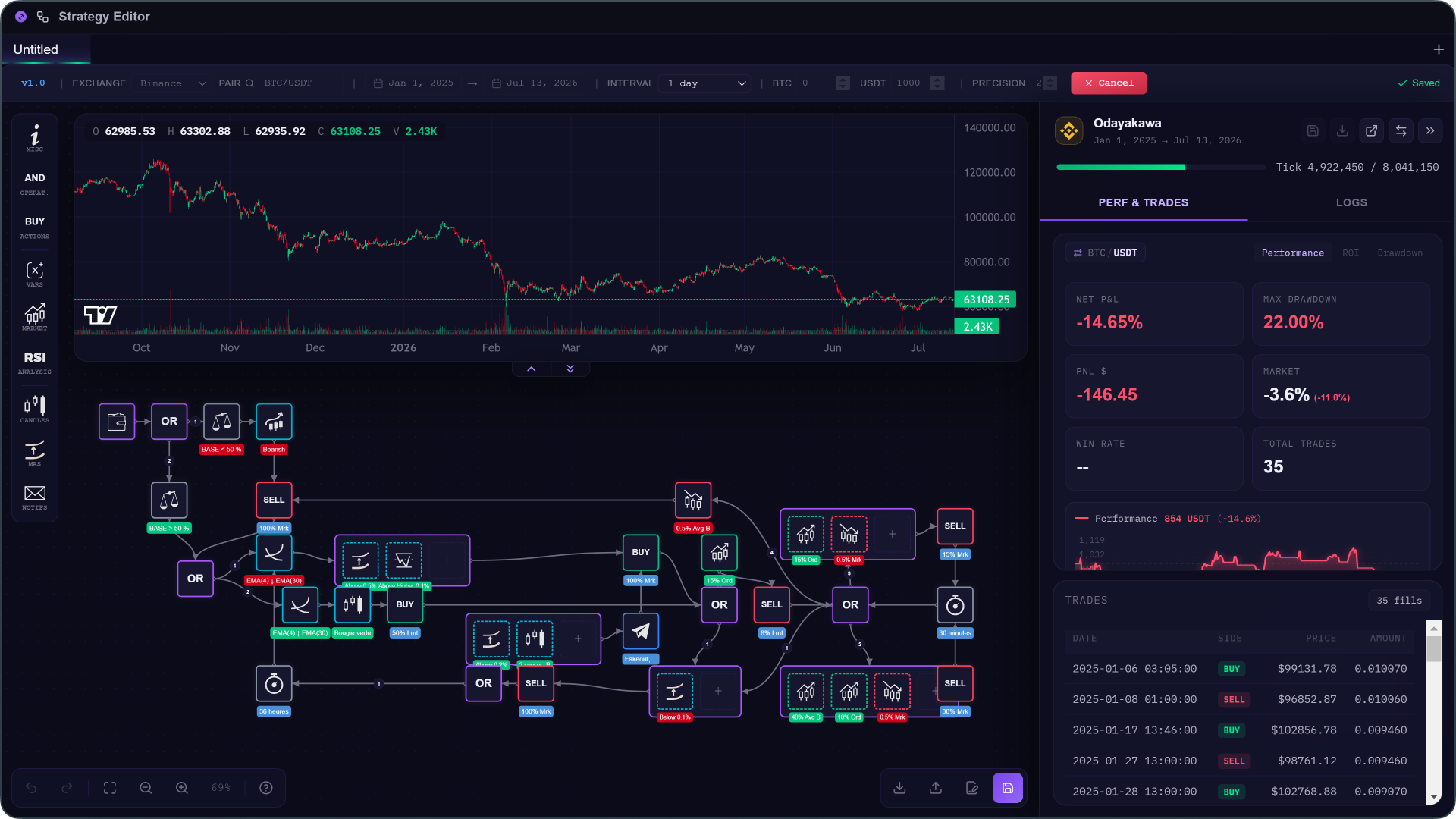
You can dial in this speed yourself with a setting in the top bar of the editor, just to the left of the Run button: Precision.
Precision defines the number of ticks the engine generates inside the candles, in other words, how finely it emulates price movement inside each candle. The lower you set it, the fewer points to simulate, the faster it runs; at 0, you're at maximum speed. The higher you set it, the more detail the engine works out inside each trade.

This mainly affects your stop losses and your trailing orders: the exact point where the price passes inside the candle decides the moment your order triggers. On a simple strategy, though, your P&L barely moves between a precision of 0 and 4.
In practice: lower the precision to prototype and chain through tests quickly, raise it back up when you want an accurate read on your stops and trailing orders before going live.
KryllOS Onboarding: A Warm Welcome to Get You Started
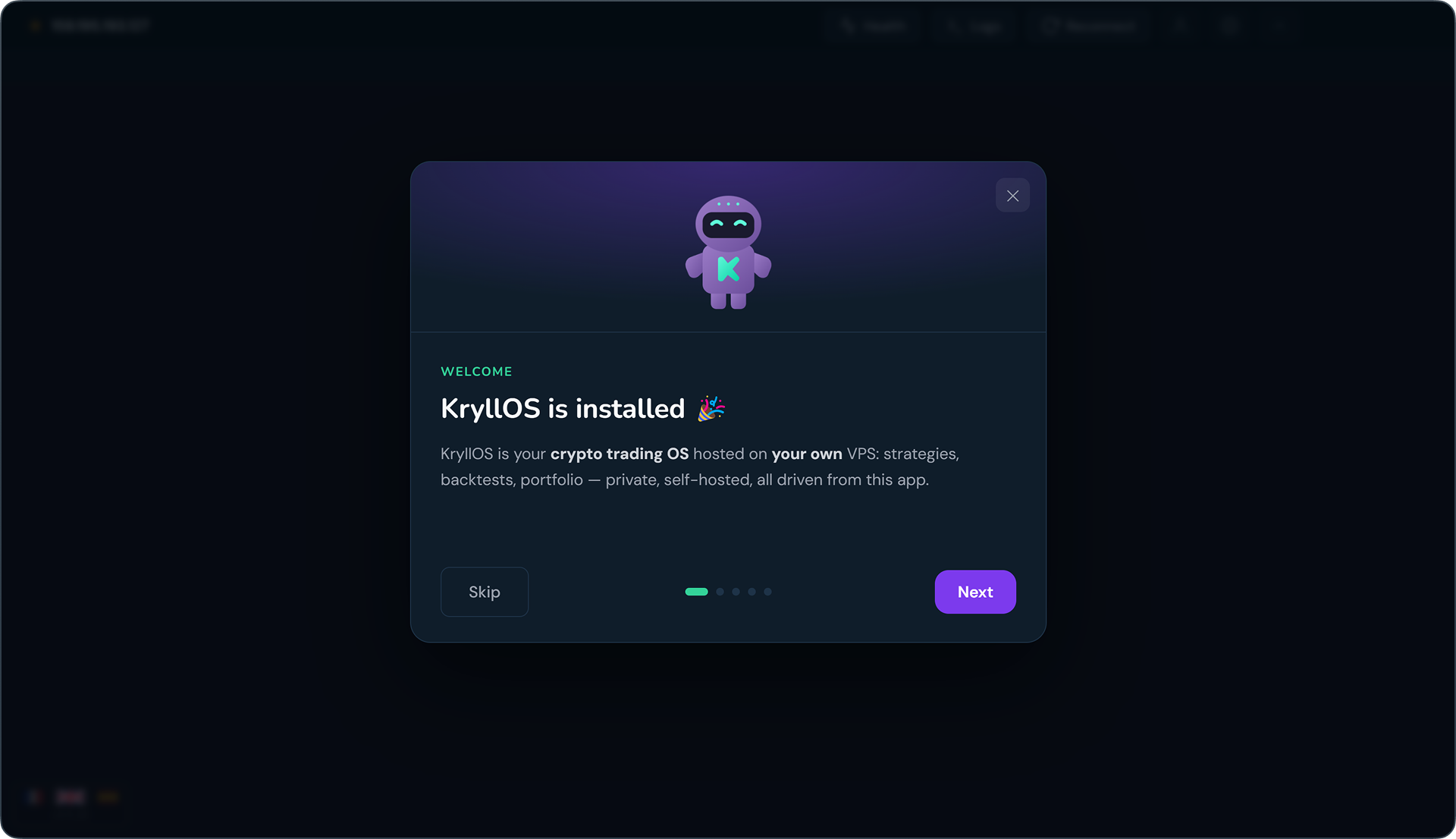
KryllOS now takes care of your very first minutes. The first time you launch the app, a quick welcome tour walks you through the essentials in five screens: what KryllOS is and what it gives you, your VPS profiles, the toolbar you summon with F10, and where to drop us a bug or an idea. No more being thrown in at the deep end, you know where to put your hands from the very first launch.